Subscribe:
Showing posts with label social media for business. Show all posts

Friday, 7 February 2014

Why businesses should be on social media

The social media world can be a daunting place. It's a world that is growing rapidly, with new features, platforms and apps appearing all the time. Whether for personal or for business use, it's hard to keep track of the newest trends, let alone learn how to use them. With this in mind, it's understandable why some companies want to shy away from social media. Every business, from large corporations to fledgling companies, already has an abundance of tasks to do. Social media ends up being another thing to add to the list.

The fact remains that social media is imperative in the modern business world. It's not just a phase, and it will continue to develop and grow, whether you choose to take part or not. Social media is the future of marketing and promotion, proving itself as an essential tool to boost your company. To put it bluntly, the sooner you get involved, the better off you will be. Don't get left behind.


Should you jump on the social media bandwagon? The answer is a resounding 'yes'. There have been many studies into the beneficial effects of social networking and marketing in recent years. A McKinsey & Co study in 2010 found that companies that embraced social media were “more likely to be market leaders”. The advantages of social media are clear: you can monitor your networks to figure out the return in your investments; you can easily measure the effectiveness of your campaigns; monitor the growth of your accounts and increase your social media reach. So how does it work?

It's all about understanding your brand and your customer base. With the right strategy, social media can make marketing and service a whole lot easier. You can essentially engage in your sales. Social media marketing allows you to monitor brand management whilst creating brand awareness by connecting with customers. At the same time, you can focus on service and monitor troubleshooting problems.

What could you achieve through the right social media strategy?


Exposure

Over 80% of online marketing firms report that social interaction between customers and businesses is the key to social media networking. Through word-of-mouth marketing, you are sure to boost your brand awareness. Exposure is key for growth, and virtual word-of-mouth marketing can help you achieve this. We trust friends over brands or adverts, so giving your customers a trustworthy product is essential. Want proof? A recent study showed that 75% of people are somewhat or highly likely to share content they like online with friends, co-workers or family—49% do this at least weekly (Chadwick Martin BaileyConsumer Pulse 2010).

Reputation Management

Social media allows you to monitor both your online and offline presence. You can see what customers and competitors alike are saying about your business. This is a huge advantage, allowing you to use the insights gained to fix problems. You can show your human side by answering questions on forums and message boards. This lends a personal touch to your business, which is harder to obtain offline. Furthermore, you can demonstrate the expertise you have in your niche, building trust with your consumers.

Branding


Through social media you can generate a recognisable identity. The tools available online can build up hype about your business, in a way that creates a buzz. If marketed in the right way, you can increase your social media reach. The more fans and followers you accrue, the better reach you'll have. UEFA, for example, passed the 37 million mark in 2013 due to their effective social media strategy.

Cost-effective

An online presence can save you lots of money in the long-term. Much cheaper than the traditional advert, cross-platform networking allows you to build your accounts and customer following without breaking the bank. It is time-consuming, but there are lots of options to hire people or distribute tasks. Social media marketing is a huge advantage for smaller companies, allowing them to compete with the larger corporations in some areas.

Measure effectiveness of campaigns

You can use many different platforms, such as Google Analytics, to monitor your online presence. Thus, you can review which online campaigns are successful. It allows you to analyse and track engagement and progress year-over-year, so that you can move forward faster by learning your former faults.

Boost your search engine rankings

The more of an online presence you have, the higher you may be in search engine rankings. If you want a higher ranking for your online networks, you can include follow links. These can be found on many networking platforms or news sites.

Explain yourself

With 24-hour customer interaction, can come 24-hour customer complaints. Well, hopefully not, but should the situation arise, be proactive about it. It is much easier to show an understanding, trustworthy side to your business online. If customers can see that your business is accessible and trustworthy, they are more likely to walk away satisfied. Through negative comments you may end up making huge improvements to your company. You may even end up finding new ideas for your business.

So start simple: establish your presence on a network that is in tune with your brand. Once you've got to grips with this, you can start to cross-promote across other platforms. So take a deep breath, dive in and get social. You won't be disappointed.

Wednesday, 12 June 2013

The New Google+ Dashboard Helps Businesses Manage Their Profiles

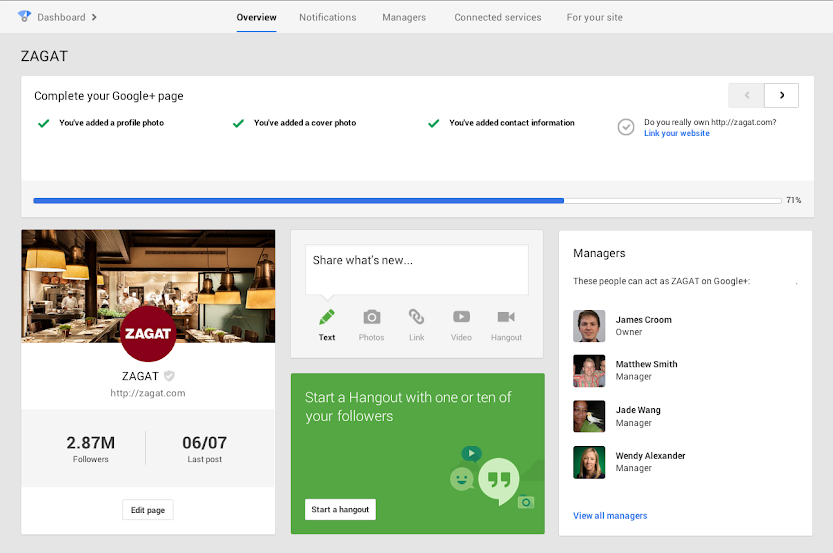
Yesterday, Google released a new dashboard for businesses and page owners on Google+, allowing them to update and change aspects of their online presence across a number of Google’s services, all from one place.

From the Overview tab on the Google+ Dashboard, business owners can change their information on Google Maps, YouTube and Search, as well as on other Google services. So, for example, if a company moved offices they could update their location on Maps via the dashboard, or even change their website URL information.

The Dashboard also has specific sections for businesses to check their “Google+ notifications, assign page managers, share photos and videos - even start a Hangout with followers”, according to Google employee Pavni Diwanji’s announcement post on Google+.

Business and page owners can also access AdWords Express and Offers campaigns on the Dashboard, while from the Insights tab they can check top keyword searches pertaining to their business, common locations requesting directions on Maps and how their posts are performing on Google+

Google has been trying to bring together all their products for some time and the new Google+ Dashboard goes a little way towards achieving this.

Do you like the new Google+ Dashboard?    

Sunday, 10 July 2011

Too Busy For Social Media Marketing Could Be Fatal


I have a friend who runs a nationwide “traditional” business, and business has been down, like it has been for most people. I suggested that he add some social network marketing initiatives, and his answer was he is “too busy.” He is not alone, according to a recent study, which concludes that only 47% of companies use social media today for marketing, despite the fact that 78% of executives polled feel it’s critical for success.

What’s the problem? It seems to me that there is abundant proof in the marketplace of the financial returns to both large and small businesses, the low cost of entry, and the ubiquity of social networks. Dell announced years ago that it had earned $3 million in revenue from using Twitter, and other businesses report daily on increases in web traffic up to 800%.

I suspect that a good part of the problem is that startup and small business owners still don’t know where or how to start. They don’t know if they should move to social networks for lead generation, branding, customer loyalty, or for direct marketing and e-commerce. My advice is to pick one, start slow, and spread out as you learn. Here are some specifics:

Create a business profile on Twitter, LinkedIn, and Facebook. A business profile starts with a business account using your company logo as your picture (avatar), rather than your photo or a picture of your cat. If you are in consulting, you are the business, so use a professional headshot. Don’t mix your personal and business profiles or messages.
Develop a marketing strategy specific to this media. Don’t use the same message on Twitter you developed for email blasts and postcard blitzes. Social media demands two-way communication, rather than outbound only. Read everything you can about viral marketing. It’s not free, so budget appropriately, but not excessively.
Start social networking with peers. Pick a base, such as LinkedIn or Facebook, to be your community, and work the territory, much like you may have learned to work a room of peers at a tradeshow or convention, or local business organization. Find out what other people are doing, and what works for them. People love to share what they know.
Experiment with social media tools. The basic tools are the platforms like Twitter and Facebook. But don’t stop there. There is TweetDeck to help you use Twitter, and YouTube for video sharing. A most valuable tool is WordPress or TypePad for blogging. You need these to add the human element to your business or service.
Proactively learn from the experts. Maybe it’s time to sign up for a few free Webinars, or even invest in an expert consultant in this area. Successful people don’t wait for their kids to teach them about new technologies, or wait to be the last one on the block to try new things. It’s all available for “free” on the Internet, but your time is a valuable resource.
Define relevant metrics and measure. That means first take some baseline measurements of, for example, lead arrival rate today, and costs associated with your current media marketing. If you don’t have this baseline, you will never know if you are making progress. Then continue to measure and learn what works, at what cost.
If used correctly, I guarantee you that social media marketing can improve your business with new leads, by bringing traffic to your website, creating a buzz around your product or brand, creating inbound links to increase your search engine ranking, and improving loyalty and trust with your customers. How could you be too busy to work on these things?

Of course, if you found this blog though your own initiative, I have to give you credit for being ahead of the pack. So print it off and deliver it to a friend who is not so high-tech. My challenge to you, then, is to kick it up a notch! When is the last time you produced a video for your business, or a podcast, or sponsored a contest with free gifts? Or are you too busy?

Saturday, 9 July 2011

Day 1 of our Live workshop today in London

Right now sitting at the back of our workshop in London, Paul explaining our strategies on Twitter and everyone seems really interested and interacting with us.
We have a full room and everyone came here early, its great to see people so motivated!
Later on I will be sharing our strategies on Facebook, it is great to be able to have these Live workshops and be able to have 1 to 1 with all the people here, that is way we keep our workshops to very low numbers, so we can get to interact with everyone and make sure they come out of the workshop been able to just keep running their business online.
Here a look of how our workshops are....

Wednesday, 22 June 2011

IBM Aims to Bring Social Media Into Compliance


IBM (NYSE: IBM) is promising to deliver a solution that will enable companies to include information from social media platforms in their regulatory compliance reports.

Compliance capability is "fundamental to reducing a barrier that many companies have encountered as they look more closely at using social media for business process integration," Alistair Rennie, IBM's general manager of collaboration solutions, said in a teleconference on Monday.

IBM is expected to formally announce the new solution -- called "Actiance Vantage for IBM Connections" on Tuesday, the opening day of the Enterprise 2.0 conference taking place this week in Boston, but the solution won't be available for purchase until the third quarter of the year.


A Social Media Cloud
In addition to unveiling its regulatory compliance offering, IBM also plans to use the Enterprise 2.0 stage to announce plans for opening a data center that will offer cloud-based social media solutions to companies in the Asia Pacific Region. The center, to be based in Japan, is scheduled to start turning on social media platforms for Asia Pacific customers by September.

The seeds for the regulatory compliance solution were planted as far back as January 2010, when the Financial Industry Regulatory Authority -- a watchdog agency for U.S.-based securities firms -- issued guidance on the importance of monitoring and tracking information passed through corporate social media sites for purposes of regulatory compliance, Rennie said.

Social media content is like all other content created by companies, meaning it's subject to the same rules, laws and customs, he pointed out, citing a February 2011 report from Gartner (NYSE: IT).

"By the end of 2013, half of all companies will have been asked to produce material from social media websites for e-discovery," the Gartner report states. "So, enterprises need an overall governance strategy for all applications and information, and this strategy should include content created on social media."

A Blended Solution
Against that backdrop, IBM is partnering with Actiance, a supplier of e-security and compliance applications, to develop its social media compliance offering. The solution will blend Actiance's e-compliance capabilities into IBM's Connections platform, which offers a range of tools for building and managing social media channels such as blogs, wikis, forums and virtual communities.

Once it is available, the solution will be a major advancement for companies in regulated industries that have struggled with how to maintain a certain level of security and integrity around important data that might be floating through corporate social media channels.

"We continue to see social media growing as a tool for business transformation," Rennie said. "It's difficult to find a customer that doesn't want to take advantage of the potential of a social business environment, but -- as is the case with every major technology change -- we continue to run into questions about managing security and risk."

Real-Time Data Tracking
Actiance Vantage for IBM Connections will address those issues, Rennie explained, by giving companies tools to monitor, track and analyze data generated in social media posts and conversation threads.

"This all takes place in real-time," he noted. "I can't overemphasize the need to track this information in real-time. The pace at which information moves in a social environment is unlike that of most traditional collaboration environments."

The new IBM solution will give users a dashboard through which they can monitor social media traffic and pick out bits of information that need to be saved for purposes of regulatory compliance, Rennie said.

"With the Connections technology, every piece of communication is auditable," he explained. "We also are using advanced analytics that will allow for recommending that users view content they might not have found on their own."

For the past two years, IDC has listed IBM as the leading producer of revenue from social media software, and Rennie believes these new offerings should help it maintain that position

Social Media Analysis in Six Steps


Whether you're a seasoned social media user or a beginner, you can benefit from this three-part series focusing on social media planning, broken down into the following parts:

1.Social media analysis
2.Social media strategy
3.Social media plan
Asocial media analysis should define an organization's online goals and target market as well as the existing resources it has to apply to social media efforts.

A social media strategy should include how an organization can improve social media optimization for its existing website as well as recommendations of other social media tools and how an organization can leverage them.

For each tool recommended in the social media strategy, the social media plan should include an overall strategy for applying the tool specifically to an organization's needs and tactics for managing and optimizing the tool. The resulting plan should reflect the needs and resources outlined in the social media analysis and strategy.

6 steps for completing a social media analysis
1 Perform a SWOT analysis in addition to the items below.
The Canadian site SEO Wizardry has a nice example of social media SWOT analysis.

2 Define the organization's target market.

• Here is a good article by Success Designs on how to do define your target market (they have some other good resources here, too).
• And another by Blog Case about marketing to your target audience

3 Define the organization's online goals.

What, specifically, does the organization want to accomplish with social media?:

• Get the word out about their brand.
• Offer a platform for getting a specific message out.
• Target new customers.
• Sell more products.

4 Assess the resources available to the organization.

• Outline the resources the organization has on hand to facilitate social media efforts.
• Estimate how many hours a day the organization can afford to expend on social media efforts based on this outline.

5 Analyze the organization's existing website:

• Is the organization's existing Website social media optimized?
• Does it offer ways for visitors to interact, share or collaborate?

6 Analyze the organization's existing social media efforts.

• If the organization already has some social media accounts in place, are they optimized?
• Does it seem they are offering content relevant to their target market and goals?

more to come soon....;)

Social Media Return On Investment? A different perspective


Do "likes" and retweets add up to sales? Who knows? And who really cares? We're in the I Love Lucy era of social-media marketing, a golden age of unaccountability.

THIS YEAR, AUDI RAN the first-ever Super Bowl commercial to feature a Twitter hashtag. Did you miss that watershed moment? Don't feel too bad: The hashtag -- #ProgressIs, a take on the carmaker's line "Luxury has progressed" -- flashed on the screen for just a second, near the end of a surreal and entertaining ad that featured millionaires trying to escape from a minimum-security prison, and a cameo by, who else, sax man and Lite-FM staple Kenny G.

In addition to pushing the hashtag on TV, Audi purchased a Promoted Trend ad from Twitter, and it hired Klout, a startup firm that combs through Twitter and Facebook in search of the most "influential" people online. Klout helped Audi find more than 1,100 people to reach out to about the campaign -- 200 of them received an Audi travel mug and flashlight. Klout's Audiphiles tweeted more than 12,000 times about the hashtag, creating a viral chain of Audi-related chatter online. The company then chose the best tweets containing #ProgressIs; the winner, @jetsetbrunette, won a trip to California to test-drive some Audis, and she also got to choose a charity to which Audi donated $25,000.

But what did Audi get out of all these influencers' tweets? Did the Twitter campaign prompt anyone to consider buying an A8, say, or to go into a dealership to test-drive one? Did seeing the #ProgressIs tweets at least inspire an outpouring of positive brand feelings toward Audi?

The company doesn't know. "Today the equation to measure that doesn't exist," says Doug Clark, Audi of America's general manager for social media and customer engagement. Audi has a full-time team monitoring its presence on social-media sites, it's constantly posting new content, and it has even held special events for the most devoted members of the online Audisphere. The best Clark can do to suggest that all this work has paid off is offer a study by Visibli, a social-marketing analytics company, which recently found that Audi has the most "engaged" fans of any entity on Facebook. Audi's more than 3 million obsessives apparently outshine even Justin Bieber's minions in their willingness to click the like button.

Clark concedes that, so far, he doesn't have any numbers to prove that all this engagement has resulted in, you know, selling more cars. Amazingly, the company isn't too interested in finding out, either. For Audi, Facebook and Twitter "are places where we know tech-minded consumers are active, where they're seeking to engage with the brand," Clark says. "But can I say that a fan is more likely to buy an Audi? No."

Audi, like almost every major brand in the world, is jumping onto Twitter and Facebook in a big way. EMarketer estimates that 80% of companies will participate in social-media marketing this year, nearly double the number of just three years ago. All of them are feverishly working to get consumers to "engage" -- to "like," to tweet, to comment, to share. And they're spending a tidy sum to do so. According to BIA/Kelsey, a media consulting firm, companies spent about $2.1 billion on social-media advertising in 2010; the number is projected to grow to nearly $8 billion in 2015.

The gold rush has inspired a wave of tech startups, like Klout, that are looking to help firms navigate the tricky social-ad scene. These companies promise to monitor and measure the impact of Facebook and Twitter campaigns, and to find the best ways to boost those efforts. Despite this technology, though, social-media marketing often feels like a throwback to the golden age of TV: At least so far, marketers can't predict or measure the impact of their campaigns with anything near the precision they're used to elsewhere online.

What's more interesting is that brands truly don't seem bothered by this. Being on the leading front of marketing while not having to account for their efforts liberates them. "We're trying different ways to help us better understand the 'value' of a Facebook like," says Brad Shaw, Home Depot's VP for corporate communications and external affairs, echoing several other social-media marketers. "But at this point, revenue is not the intent." Applied to social media, William Goldman's famous line about Hollywood would go something like this: Nobody knows anything, and they don't care. You're forgiven for wondering: #ProgressIs? #Really?

RANK AND FILE


LATE IN 2007, JOE FERNANDEZ, a young tech-obsessed guy, had to get his jaw wired shut for three months while recovering from surgery. The only way he could communicate with his friends and family, he says, was through Twitter and Facebook. But he found his medically imposed silence to be a revelation, rather than an ordeal. "I could tell people my opinion on anything instantly, and the people who trusted me were acting on what I said," Fernandez says. "It hit me that for the first time, word of mouth was becoming scalable and -- even more important -- the data about all of these interactions were available."

Fernandez quickly began working on a way to tie all these data into a comprehensive picture of each of our online lives. What he came up with was Klout's signature product, the Klout Score, an integer from 1 to 100 that summarizes every person's influence online. The score is determined by a number of factors -- including how influential your followers are and how many people retweet or respond to things you say online. It has become, in some circles, an important measure of influence. People are reputedly putting Klout Scores on their résumés, and a few brands, such as Las Vegas's Palms Hotel, are using Klout to identify potential online VIPs for preferential treatment. Justin Bieber, of course, is the king of Klout: He has a perfect 100. Everyone else is second fiddle. Barack Obama gets an 87, the Dalai Lama gets an 86, and Jay-Z struggles with a mere 67. (For the record, I earn a 64 -- good enough for "thought leader" status and probably the only time I'll be this close to Jay-Z in any public ranking.)

Klout has now amassed enough data to measure the influence of 75 million people online, and it can slice and dice these numbers. For instance, Fernandez says Klout can identify the most influential people who talk about sneakers in Seattle, or the most-listened-to tweeters on skin-care products in San Francisco. When companies come to Klout looking to target those influencers, the company can track how their messages echo across the social-media landscape. How many extra tweets did Nike get by focusing on those Seattleites?

But what Fernandez can't track is what happens when people read all those comments or tweets: Does the marketing change anyone's feelings about Nike? "I think we'll get there eventually," he says, musing that over time, brands will give Klout -- and other social-data-analysis companies -- sales information to correlate with online chatter. Still, the problem won't be easy to solve. For one thing, social-media marketing, unlike search ads, catches most customers when they're far away from making a purchase decision. This makes it menacingly difficult for firms to determine what ultimately led to a purchase. Was it something you saw on Twitter or Facebook three weeks ago, or was it the drive-time radio spot you heard this morning?

Wildfire CEO Victoria Ransom is bringing corporate Facebook fan pages to life via contests and sweepstakes. | Photograph by Robyn Twomey


That gets to the second reason that social-media marketing hasn't yet proved itself: So far, advertisers aren't asking for any proof, and that limits the ability of firms like Klout to figure out if what they're doing really works. "My life becomes a million times easier if I can show that if you spend $1 with us, you get $1.10 out," Fernandez says. But for many big brands, the amount of money being dedicated to marketing on Facebook and Twitter is small compared with the rest of their advertising expenses. "For a lot of our clients, what they're spending with us is coming out of their 'experimental' marketing budgets," he says. In other words, they don't feel much pressure to account for their efforts. "No brand is challenging us on this. We challenge ourselves way harder than any brand does."

One current alternative is to embrace less sexy, but more Internet-friendly, direct-response advertising models. "Sweepstakes, contests, and coupons have always been popular, long before the Internet was around," says Victoria Ransom, CEO of Wildfire Interactive, another Silicon Valley advertising startup. Like Klout, the three-year-old firm was founded by accident. Ransom and Alain Chuard came upon the idea while running their previous company, a global adventure-travel firm. They wanted to expand their firm's Facebook presence, "but we realized pretty quickly that we were going to have to give people a reason to become fans of our page," Ransom says. The company had run sweepstakes on its site before, but it found that translating those to Facebook wasn't very easy. "We figured we weren't the only ones facing that challenge," she says. The company created a way for all kinds of businesses to create their own promotional applications on Facebook. "Within a few weeks, we'd received calls from both Kayak and Zappos," Ransom says. "We went, 'Oh, maybe this will be bigger than we thought it would be!' "

Wildfire's twist is making sweepstakes and contests social. They're built as Facebook apps, and they're promoted widely on Twitter. Ransom says that Wildfire can often track the success of its campaigns by integrating with its customers' transaction databases. For instance, the firm recently ran a promotion for Jamba Juice that allowed people to collect a "lucky" coupon from Jamba's Facebook page. You'd only find out the value of the coupon if you took it to a Jamba Juice store, and some of the coupons would pay out cash prizes of up to $10,000. The campaign drove tens of thousands of people to Jamba Juice locations; every time someone used one of Wildfire's coupons to make a purchase, the smoothie chain could credit that customer to the promotion.

Still, Wildfire's campaigns suffer from a problem that's common with social-media marketing: Because they're so new, and because they often depend on catching uncertain viral cascades, their performance is difficult to predict. "If we put a dollar in the Google machine, we know exactly what's going to come out," says David Sobie, VP of business development at HauteLook, a Nordstrom subsidiary that runs a members-only, daily-discount fashion site. Sobie has run many campaigns with Wildfire, and he says, "We're often surprised -- things that we didn't think were going to take off have been incredibly successful. And others, where all the metrics suggested that something should have been successful, have turned out not to be."

Klout CEO Joe Fernandez, right, is creating an “influence graph” for social media and then adding brands to the mix. | Photograph by Robyn Twomey


NOT LONG AGO, I was offered a tour of the customer-service department of the future. It's a bright, gleaming space; costs almost nothing to operate; and boasts the friendliest, most knowledgeable representatives in all of American commerce. Where is this call center? And who runs it?

It's online. And it's run by you. Lithium, a 10-year-old company based in Emeryville, California, builds and hosts online discussion forums for companies to let their customers help themselves, and it's one example where social media already seems to be helping companies pay the bills. For companies like Comcast, which have high-profile rapid-response complaint centers, Lithium's technology has revolutionized customer-service operations, usually an expensive part of the business. CEO Lyle Fong estimates that Lithium's work revamping AT&T's online community resulted in AT&T saving 16% on telephone customer support in January 2011 compared with 2010.

We're a long way from Bieberville, but this being social media, no one wants to talk just about minimizing call volume. At Home Depot, Lithium powers a vibrant discussion site where customers discuss home-improvement projects and the products and instructions to use them. "We can look at how your users interact with each other on your site," Fong says, "and we can tell you, 'Hey, here are your community members who are going to be your most passionate fans, and if you treat them right, they're really going to give back.' " At Sephora, another Lithium client, the discussion site has become a place where some of the company's most feverish fans -- women who spend 10 times more than the typical customer -- log many hours offering advice to everyone who comes along.

Sephora hasn't calculated all the additional sales that this system has generated, nor the labor it might be saving now that its best customers, rather than employees, are answering people's beauty dilemmas. Bridget Dolan, Sephora's VP of interactive media, says that at some point, the company may decide to do just that. Right now, though, "we aren't saying, 'Does every dollar we spend turn into revenue?' " she admits. "No one here is hounding me for the ROI."


Saturday, 30 April 2011

The KISS Method for Determining Social Media ROI

Attend any corporate meeting on social media initiatives and it’s likely that you’ll hear a question or two along the lines of “how is this selling us more product” or “what’s the ROI on these activities”? Unfortunately, many social media strategists get caught up in the numbers that relate specifically to social media and they forget about the numbers that are meaningful to their business.

Obviously, each business or organization will have different Key Performance Indicators (KPIs) that determine the success of social media activities, but many organizations can benefit from using some, or all, of what I call the K.I.S.S. method. No, it’s not “keep it simple, stupid”, with respect to social media, KISS stands for the following:

K is for Knowledge management – For the last 10 years, the nebulous term “knowledge management” has been used to try to identify ways to capture the knowledge stored in employees heads and turn it into meaningful information that organizations can use. The dangers of ignoring knowledge management is that employees who leave your organization take their “tribal knowledge” with them, resulting in loss of access to the information and increased training costs for the persons’ replacement. The loss of this knowledge can ultimately impact your customer satisfaction if the tribal knowledge was never captured in any organizational knowledge base.

To avoid the loss of employee knowledge, you can leverage social media by creating an internal platform where your subject matter experts can share their knowledge, thus preserving it for organizational use. Wikis, idea networks, blogs, and social Intranets are a great tools that can be used to encourage employees to share what they know.

Keep in mind that you may need to provide employees with incentive to participate. Explore whether it would be beneficial to offer monthly incentives to those employees that contribute the most valuable content using internal social media tools. A $50 restaurant gift card that saves you thousands in training costs and keeps customers happy is usually a good investment.


I is for Intelligence
– Think of social media as a direct pipeline into information about your products/services, your customers, and your competitors. If your customers don’t like your products or services, they will share their displeasure via reviews, tweets, and posts. The same holds true for your competitors products/services. Additionally, if you listen closely, your customer and potential customers will tell you what they want from you with respect to new products/services. Take that one step further and engage with the community that makes up your customer and prospects, and you can identify new ideas that might not have been developed by your R&D department.

S stands for Sales – Social media can be a great way to connect with your existing customers and empower them to become your brand advocates. Customers are great if they continue to use your product, but they’re even better when they share their experiences with others and encourage their friends and family to try your product. This isn’t a new concept, it’s been around forever and have been successful (remember Faberge shampoo’s “and they told 2 friends and so on…” campaign?)

Social media also offers a significantly cheaper medium for advertising then traditional print, TV, and radio advertising. Look for ways to get your ads in front of highly-targeted consumers using social advertising on channels like Facebook and YouTube.

Don’t forget that social media can also give your sales professionals an easy way to identify new prospects who are looking for a product or service that your provide. LinkedIn Answers and Twitter are great ways to find new potential customers.

S stands for Support – One of the most often overlooked value propositions for social media is that of customer support. Anyone who has ever worked in a call center knows that the most expensive way to provide service to a customer (other than coming onsite to their location) is to have a call center technician help them on the phone. That’s why call centers track important metrics like First Contact Resolution (FCR), Time on Call (ToC), Cost per Call (CpC), and – of course – Customer Satisfaction (CSat).

By capturing your organizational knowledge (via the “K” of Knowledge Management), you can enhance your internal call center knowledge base, allowing your call center technicians to locate and provide answers more quickly, which could decrease Time on Call and increase First Call Resolution. Decrease in TOC and increase in FCR often results in an increase of CSat.

As you can see, it doesn’t take a rocket scientist to start thinking of ways that engaging your employees and customers through social media can improve your operations, open up opportunities, and positively impact your customer satisfaction.

Have ways that you have implemented the KISS method or have additional ideas for positively showing a ROI for social activities in your organization? I’d love to hear about them in a comment or a Tweet.

Thursday, 6 January 2011

Facebook Trumps Google!

It looks like 2010 was indeed the year that Facebook's success exploded.

For the first time ever, U.S. Web surfers visited the social networking site more than any other site in 2010, beating out Internet behemoth Google, according to a report from Hitwise, an Internet analytics firm.

Facebook, which had a flood of good and bad publicity last year, grabbed 8.93% of all U.S. visits between January and November 2010. Google, which had been in the top spot in 2009, slipped to the No. 2 position with 7.19% of all visits, Hitwise said.

The analytics firm also reported that Yahoo! Mail came ranked third with 3.52% of all visits, while the main Yahoo! site was fourth with 3.3%. YouTube rounded out the top five with 2.65% of all site visits.

Facebook Watch
Facebook profile helps to catch a thief
Facebook passes Google as most visited site of 2010
Fixing Facebook: Tips and tricks for handling common complaints
Facebook rakes in $2B in 2010
Facebook's Zuckerberg is Time's Person of the Year
Update: Facebook rolls out redesigned profile pages
Facebook's Christmas Tree virus only a hoax
Zuckerberg talks Facebook Messages, mistakes, social revolution
Hackers, spammers will target Facebook Messages, say experts
QuickPoll: Should Google, Yahoo and Hotmail be worried about Facebook?
More about Facebook Facebook had been creeping up on Google during the last several months.

While Google has long been at the top of the heap when it comes to grabbing the most visitors -- and time spent on a Web site -- Facebook began making its mark last summer.

In September, Online researcher comScore reported that for the month of August, Facebook edged out Google in terms of how much time U.S. users spent on a Web site. U.S. users spent a total of 41.1 million minutes on Facebook in August, compared with 39.8 million minutes on Google's various sites, including Google News and YouTube.

And last March, Facebook hit another milestone when the social networking site replaced Google as the most visited Web site in the U.S. for a full week.

Hitwise reported over the weekend that Facebook marked another small victory for the year. After analyzing the top 1,000 search terms for 2010, Hitwise calculated that the word "Facebook" was the top search term for the year.

"This is the second year that the social networking Web site has been the top search term overall, accounting for 2.11% of all searches," Hitwise reported. There actually were four variations of the term "Facebook" in the top 10 searched-for terms of 2010: facebook; facebook login; facebook.com, and www.facebook.com.

Other search terms making the top 10 include: Craigslist, Myspace, YouTube, eBay, Yahoo and Mapquest.

Tuesday, 28 December 2010

5 Ways To Gain & Keep Your Customers Trust Online

Now more then ever, organizations are opening up to the public and becoming transparent due to the impact and evolution of social media. Social media has forced small and large organizations to join in on the conversations that people are having about their brands. If you want to continue growing your business and its brand then you need to gain trust from your customers immediately. Below I listed 5 simple ways to keep and gain your customers trust in an online environment.

  1. Be consistent with all of your branding. In order to keep and gain trust you need to keep a consistent branding strategy across all of your platforms on and offline. What this does is shows your prospects and consumers that you are consistent and clearly portrays who you are, everywhere, all the time. Something to keep in mind is the consistent branding all the way down to the simplest things such as consistent color schemes. These color schemes should be followed through from your website all the way through to your business cards and letter head. Being consistent tells your customers that “this is who you are all the time, with no smoke or illusions”.
  2. Let a personality show through. People trust, and buy, from people. This is the reason its important to let a person, or at least your businesses personality, shine through in your online presence. Especially in your businesses social media platforms such as Facebook and Twitter. Be you and tell your story, you may surprise yourself how people will react to this if you are used to hiding behind the curtain and letting only your business speak.
  3. Respond to comments and reviews both negative and positive. I have many conversations with business owners regarding the conversations that are happening on their social media pages. It is very common for the conversation to go right into the direction of customer reviews. If you are looking to keep your customers trust then leave the customer reviews to the customers and don’t think making a false review for your business will help you. This seems like common sense and basic but I have come across a few instances where employees or business owners themselves feel the need to create false customer reviews about their own business. This can shatter the trust and will dilute any real customer experiences especially good ones. On another note, take both negative and positive reviews as a learning experience and use them to show the public how you handle situations. This over the long run will spotlight your business as positively as possible, and the goal is to have that positive outshine the negative.
  4. Capture client testimonials. Create a system where your capturing testimonials from people who use your product and or service. By doing this you are creating a great way for you to gain your future customers trust. In many cases before someone decides to purchase something from you they research your business online and part of that research will be in the form of reading your past testimonials. Don’t just capture the testimonials but make them readily available for your future customers to read and gain trust in your brand before they purchase from you. Post them on all your platforms. Invite people to read about these experiences, so when its time for them to use your company they already are competent in the fact that they made the right decision.
  5. Be transparent and authentic. The many social media platforms that are available these days have made it easier then ever to allow your brand to become transparent and authentic. Being transparent enables your customers to see into your company and gain trust on a whole new level. Social media makes this easy by allowing you to respond to whatever issues that your business is having in a public manner for all to see. This will automatically create the sense of authenticity of your brand and will ultimately create the trust your brand and organization is looking for.

Have you gained the trust of your online community yet? What are your tactics towards creating trust in your organization? Are you using social media as a tool to create transparency and put a face behind your company?

Wednesday, 24 November 2010

Siemens release their Social Media Do's & Don'ts

The social media or social channel is a new way of interacting with customers, which means that most firms are on a learning curve with it. To assist companies, Ross Sedgewick, senior director, global marketing for large enterprise solutions, Siemens Enterprise Communications has come out with these “Don’ts and Do’s Social Media for The Enterprise."

1.DON’T: Assume customers won’t notice your absence in social media channels

DO: Keep current as communication channels evolve

Customer contact channels never stand still...neither should you! A recent Yankee Group (News - Alert) study revealed that 70 percent of consumers want to be able to leverage social media sites to see real-time availability of company experts in area such as billing and technical support. Customers are searching for you online, so be readily available.

Also, being present with new media not only gives you the opportunity to serve customers where they are congregating and communicating, but being early or first in your industry allows you to differentiate yourself on customer service and accessibility.

2.DON’T: Miss out on conversations with your customers

DO: Identify where your customers are communicating on social media, and target relevant corporate or public outlets for monitoring

Take advantage of powerful automated tools that monitor, filter and notify of customer, stakeholder and prospect activity on social networks or community sites. The filtering criteria can be customized based on your objectives and highly tailored to your business needs. The same Yankee Group survey uncovered that 67 percent of employees need more tools to track and manage their social communications for business purposes.

3.DON’T: Cripple your contact center by keeping communications methods silo’ed

DO: Leverage the effectiveness and efficiencies of your contact center via integration

Leverage the skills, resources and processes by integrating key social media outlets with your contact center technologies, tools and processes. As volumes grow, using ad hoc methods or dedicated personnel may be inefficient and ineffective. Better to build in social media tools from the beginning and allow them to become part of how you do business.

4.DON’T: Let employees’ social media usage become a liability for your business

DO: Train employees on the subtleties of effective social media interactions

Social media interaction is somewhat different than e-mail, voice or face to face. Remember, social media conversations are usually in the public domain! Enforce company social media guidelines and keep employees educated.

Often it can be wise and effective to move and morph a social media dialogue into a richer and/or more private media e.g. voice, e-mail and chat. Communication that begins in a social networking forum should be moved to phone or e-mail for ongoing conversations.

Tuesday, 23 November 2010

Social media replaces phone on the road

A whopping 80% of travellers in a new study say they access social media sites throughout the day, while more than 60% now use social media to reach family and friends on the road. As many as 39% say they can’t live without social media, with one-third of users logging on multiple times an hour. The results show clearly that social media has become the number one contact tool while on the road.

Waiting for word from a loved one on the road? Don’t sit by the phone. These days, chances are they’ll keep in touch through social media, according to a survey released yesterday by Sheraton Hotels & Resorts.

More than 60% of respondents in the global social media study use social media to stay in touch with family and friends while traveling; more than a third (36%) say they’d rather log on than make a call to share good news.

Overall, survey respondents ranked social media somewhere near air and water as a must-have in their lives. Four-fifths of respondents said they access social networking sites throughout the day, while 39% said they “could not live without” social media sites. One-third of respondents said they log in multiple times each hour. Habits barely shift on the road. One fifth of respondents say that they check social networking sites multiple times throughout the day while traveling.

The global study was conducted by Studylogic LLC, which surveyed 4,204 people via phone in the USA, UK and China. Sheraton recently completed the roll-out of its signature offering “Link@Sheraton experienced with Microsoft,” a technology-driven social hub that keeps travelers connected 24/7 at nearly 400 hotels around the world.

Social Networking Blurs Lines between Business, Pleasure
Careful what you post. Before meeting a new business contact, more than half of those surveyed check out their new contact’s social networking profiles (54%). Nearly 60% say they have not hired a candidate based on a negative impression from a social-media profile. More than half (54%) of respondents say they know someone who has been fired for something said or posted online.

Regardless of pitfalls, social networking’s popularity as a networking tool continues to grow. More than half of all respondents (56%) agreed about the importance of doing business with people active in social media channels; 55% use online social networking to meet new business contacts and maintain current ones.

And many use social media to mix business and pleasure – literally. More than half of those surveyed have arranged a romantic interlude on the road using social networks, with men more likely to do so (45%) than women (40%).

Fact or Fiction?
Don’t always believe what you read. Nearly 70% of respondents say they aren’t honest on social networking sites; 27% of those fib “a little,” 21% flat-out “lie,” and 20% admit that their postings are total fabrications. Women are more inclined to tell little white lies online; men were more likely to be 100% honest (46%) versus their female counterparts (18%).

Who Are People Visiting While on the Road?
More than 50% of all Sheraton guests use the Link@Sheraton during their stay. Facebook is the most visited site at the Link@Sheraton, with 75% of Link users logging in during their stay. More than 60% of those surveyed (62%) find that social media makes it easier for them to meet people while traveling for work.

Social Media as a Travel Planning Tool: 64% say yes
64% said they use social media to make their travel plans and within the 25-34 year old participant group, the number is even higher; 76% look to popular social media sites to plan their next getaway.

”Along with the bigger shift toward social media from other forms of communication, what the survey drove home for us was that an experience like Link@Sheraton isn’t a luxury for guests, but a necessity,” said Hoyt Harper, SVP and Global Brand Leader for Sheraton Hotels & Resorts. “They expect total connectivity.”

Designed as a social environment, The Link@Sheraton invites guests to interact with each other while they check their email, research local attractions and even print boarding passes using free Wi-Fi and Internet-enabled computer stations. It also features a Link@Sheraton Café, televisions and daily newspapers.

Tuesday, 16 November 2010

Social networking to replace email by 2014

The business benefits of social software platforms will lead to email being replaced as the primary means of communication by 2014, according to analyst Gartner.

Increasing business use of tools such as Twitter and Facebook has resulted in more demand for such systems, says the firm, which predicts that 20 per cent of organisations will use them as their key communication medium by 2014.

Greater security, the availability of the so-called “white-labelled” social networks and more tolerance from organisations allowing use of personal accounts at work are among the factors influencing the business uptake of such tools, says the study.

"The rigid distinction between email and social networks will erode as both become more developed. Email will take on many social attributes, such as contact brokering, while social networks will develop richer email capabilities, " said Matt Cain, research vice president at Gartner.

"While email is already almost fully penetrated in the corporate space, we expect to see steep growth rates for sales of premises and cloud-based social networking services," he said.

The analyst also predicts that in the next couple of years more than half of global businesses will be engaged in some sort of microblogging, with more control and security features, though standalone enterprise use of Twitter-like tools will have less than five per cent penetration.

And only 25 per cent of businesses will routinely use social network analysis to improve performance and productivity through 2015, according to research.

The study adds that more than 70 per cent of IT-led social media projects will fail as technology departments tend to provide an IT solution rather than a social solution that targets specific business value. Gartner says that businesses will need to develop better skills to be able to develop adequate social media solutions.

Gartner also predicts more activity around the development of mobile-based collaborative tools over the next few years.

"As more organisations consider replacing desk phones with mobile phones, they may wish to anchor their collaboration tools also on the mobile phone," said Ken Dulaney, vice president and distinguished analyst at Gartner.

Tuesday, 9 November 2010

Using Social Media for the Success of Small and Medium Businesses

If there’s one aspect small and medium-sized businesses should look into, it’s social media marketing. And it is proving to be an integral part of today’s business landscape, adapting to the rapidly evolving socially-aware Web.

Word-of-mouth has been transmuted to real-time tweets. TV reportage has been elevated to live Web streams and on-demand videos. Generally pandering advertisements have been turned into messages especially targeted to specific members of the brand’s client base.

All these have set the stage for newer practices and technologies, bringing in much brand and product-driven successes than traditional marketing tactics could ever hope to achieve. True enough, social media has proven to be a stable marketing platform, so if your company has yet to jump onboard the dynamic phenomenon that is social media marketing, you are missing out on a lot of its great benefits.

Follow the Market
According to a recent study titled “What Do Americans Do Online,” social media has risen as the number one American pastime, beating all other online activities. In fact, the Internet Advertising Bureau agrees, even claiming that “If you’re not on a social networking site, you’re not on the Internet.”

Indeed, a massive social migration is taking place and this shouldn’t come as a surprise with celebrities like Oprah Winfrey and Ashton Kutcher driving social networking sites to massive popularity. As such, social media is where the consumers are, and that is where you should set your online marketing focus on.

Ramp up Your Presence
Unless you’re carrying a pretty popular brand, it may not be easy to find you online. So take the extra step by introducing your company and your products to social media by setting up a blog and then creating profiles on Facebook and Twitter, among others. That way, people who like your products can easily find and connect with you online—and you can even pull in untapped markets through their own contacts. These can also serve as effective search engine optimization tools to drive significant traffic to your Web site and help boost your client base.

If you have a physical store, you can also invite your customers to visit, shop and sample your products. To do this, you can have your location listed on geolocation services like Facebook Places, Yelp, Google Places and both Foursquare and Gowalla. These sites will allow you to include contact details, embed maps, photos and would allow subscribers to rate and review their visit; thus increases mentions online.

Better News Distribution
Naturally, as the number of followers grows on your social profiles, you can offer your demographic different ways to receive news updates about your products or any promotion you may have. With its easy accessibility and scalable publishing capabilities, social media offers many great distribution platforms like blogs, live chat rooms, multimedia streams and social networking status updates.

Most notable of these are Facebook’s News Feed and Twitter’s stream. Because they deliver your message in real-time, you provide your followers with the freshest updates as they come, and they can react immediately—by taking part, asking questions or by spreading your message to whoever they think would be interested in their own circles. These services would also let you embed relevant photos, videos and links to give better context to your message.

Improve Social Engagements
Traditional marketing tactics would dictate that we appeal to a majority of people within our demographic. Social media marketing, on the other hand, lets you target factions of any given group, or even specific individuals. By responding to comments on your Facebook’s Wall posts or on your blog’s entries, you can address the general needs of your audience and directly engage with individuals. And this can reflect positively on your brand, showing that you’re there to listen and can also serve as an extension of the customer service hotline.

While these will keep your followers informed, you can up the value your presence offers by also showing your own personality and share other relevant content online you think others will find interesting and useful.

Enhance Your Reputation
As with the nature of social media, everyone online is given a voice. And with it, they freely express their opinions about anything, whether they are singing their praises about a company or harshly criticizing it for its bad service. And this is one unavoidable fact that happens to all brands—whether you’re a top brass institution in your industry with a global presence, or a local cottage industry with a small but loyal customer base. In this regard, social media is just the tool you’ll need as you manage your reputation online.

You can level the playing field using its many messaging platforms, addressing concerns, clarifying issues and thanking commendations as they come. You can publish a response to a rising concern on your blog, link to it from Twitter or Facebook and maybe produce a video to assure your customers of your stance and the series of actions you will take to resolve the issue.